
The awakening
It began with a 4:30am alarm.
By 5:15 I was out the door, meeting Smithy at 6am, a quick pit stop at Motors and Rotors with Dave to pick up a part, then pushing onwards to Tibenham airfield.
Four hours in the car. Four hours of my brain running at full speed, painting pictures of what the maiden flight might look like. Nice low passes. Maybe — maybe — a massive jet loop. A four-point roll. Just daydreaming. Living the dream, or something like that!
All of that went straight out of the window. More on that later.
The Arrival
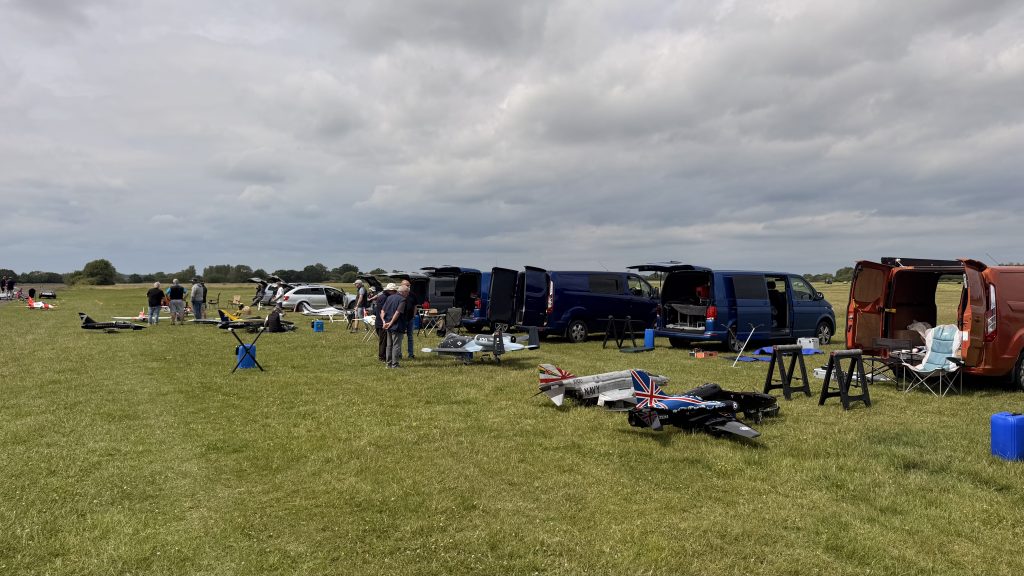
We arrived around 9:20, just in time for the pilots’ briefing.
Walking up, I already felt slightly out of place. Twenty-plus people in attendance, all with vans, all with seriously impressive jets lined up and ready to go. These weren’t beginners.
The briefing was professional and well organised – rules, no-fly zones, how many aircraft in the air at once, solo slots if you needed them. It was mentioned that there were a few maidens today and a few newcomers, so give them time and space. I appreciated that more than I let on at the time.
I was made to feel welcome. That mattered.
Back to my van – parked right at the far end, naturally – to start getting the Lancer out. Smithy was also putting something together from his van. Something a bit special, as it turned out. More on that later too.
No real nerves at this stage. I was just hoping I’d remembered everything, given it had been a while since I’d finished the jet and done the test engine run.
Stand assembled. Temporary Revoc cover removed – which is a bit of a job in itself, unzipping from nose to tail. I probably should have put the jet on the ground, unzipped it, and lifted it out. But no. All logical thinking was starting to quietly disappear. Looking back, that was the nerves sneaking in without me realising.
Back to the van for the covers and the horizontal stab. For a split second I thought I’d grabbed the wrong stab – I hadn’t. My brain cells were just beginning to clock off for the day.
Four tubes on the stab, two each side. Got those in. Checked the quick release three times on each side. The jet was starting to feel very big.
Wings next. Massive canopy off, carbon tube in, left wing on – making sure the stand supports were in place so the model didn’t immediately roll off. (That almost happened to me at home during assembly. I’m saying nothing.) Quick releases checked on both wings, all three wires plugged in and double-checked.
Then the batteries. All four of them. Checked each one was fully charged – even though I’d done it the night before. The batteries sit in pairs either side of the nose wheel, held in with velcro straps. Pink velcro straps. I put them on tighter than they’d ever been, connected all four wires, and reached for the Futaba T26.
Powered up the TX, removed the pin from the Advanced Radio smart switch to bring the jet to life. Flicked the retract switch.
“Gear down.”
That came from the TX – and I’d even remembered the right switch. Then I waited for the inevitable reminder of the retract issues I’d had during the build… but no. Buzz, click, the gear doors opened and all three wheels came down clean.
Always a bonus.
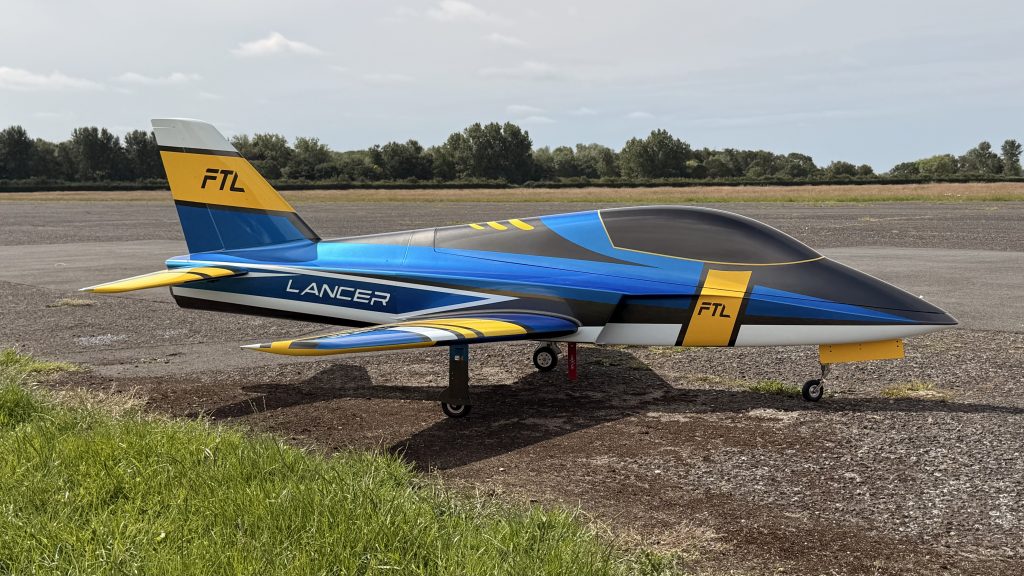
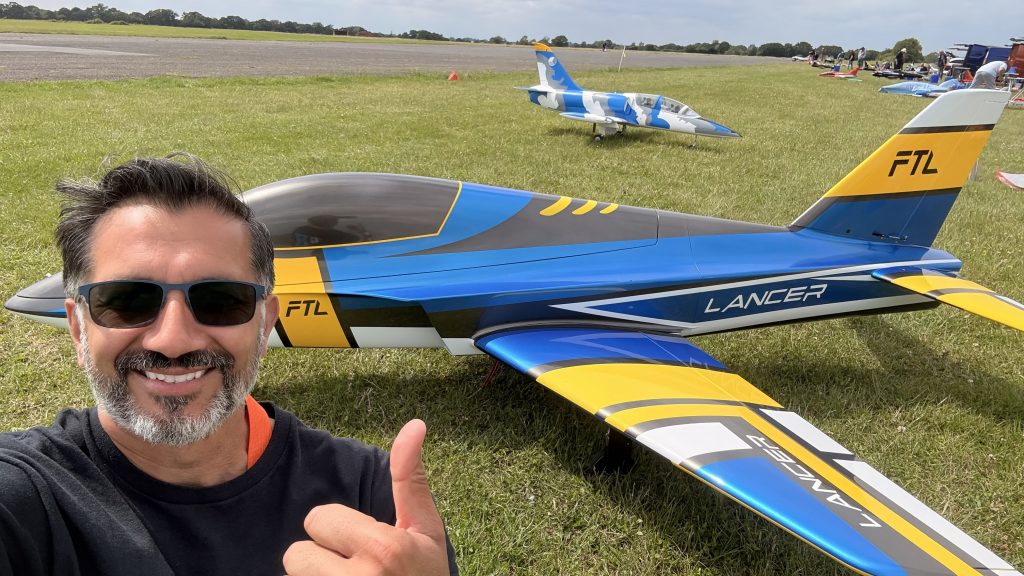
I turned everything back off and lifted the 2.8m, 17kg Lancer off the stand. Not easy. Probably should’ve asked Smithy for a hand, but he was in the zone. I remembered to bend my knees – only a year ago I’d had an operation to remove a prolapsed disc – and lowered her gently to the ground.
She looked the absolute business.
Time to fuel up. Something I’d only done once before.
Out came the rather impressive fuel container from Nexus Models, electric pump, 2200mAh 2S battery connected, and – relieved – I’d remembered the adaptor. Disconnected the fuel line, plugged it into the jet, opened the valve, removed the vent plug. Set the pump speed to low (apparently you can split the tanks if you go too fast – the air can’t escape quick enough through the vent). Smithy kindly lent me his super fancy taxi tank, which I connected to the vent pipe while the fuel tank filled up.
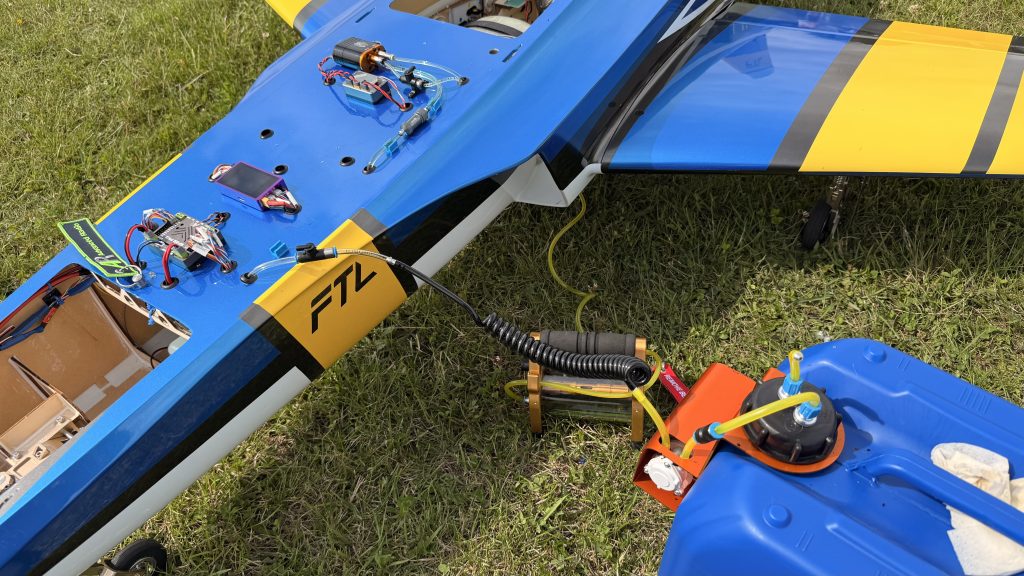
These jets take a while to fill up. Plenty of time to stand there and think.
Jet assembled. Batteries in. Full of fuel.
I looked up. Seven models in the queue. A couple already in the air.
This was real. This was about to happen.
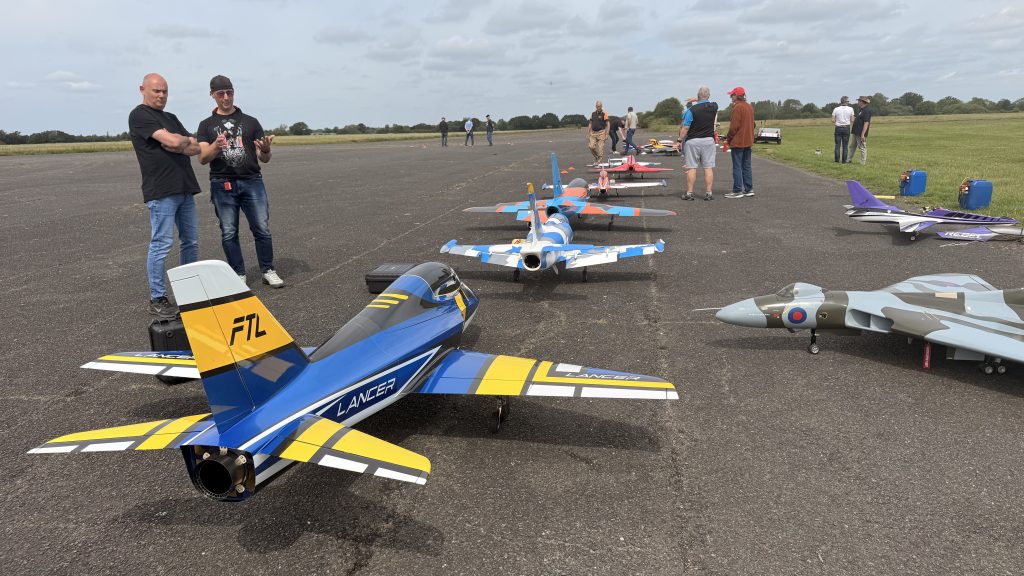
It Is Time
All of a sudden, the Lancer was one of two jets in the start-up box.
“Gear pass.” The signal that the jet in the air was starting its landing approach. Time to get ready.
Smithy stepped in to help. Lewis was there, a couple of others too. The pilot behind me in the queue was asked to hold back – it was a maiden, and my first time flying at a JMA event. He very sensibly waited until I’d landed!
Canopy off. TX on. Jet on. Fuel tap open. Canopy back on. Left aileron, right aileron. Up elevator, down elevator. Rudder left, rudder right. Flaps to half.
Then – brain fade.
“How do I start up?”
Several voices replied at once: “Trim all up, throttle stick up then back down.”
Click. Whirl.
And then that noise. That noise. The one only a turbine makes. That raw power, building, absolutely otherworldly sound as the KingTech G5 spun up. Quick too. Smithy had the nose of the Lancer and signalled me to go to full throttle – first run of the day, need to make sure there’s no air trapped in the lines.
Full power. Just for a few seconds.
And that’s when I felt it. Standing there with the engine screaming behind a 2.8 metre jet, the adrenaline hit me like a wall. I pulled the throttle back to idle.
She was ready.
Smithy pushed the Lancer out to the end of the runway, signalled, and let go.
For a brief moment I thought: should I ask him to test fly it?
No. I’m here now. This has been a long time coming. I’ve got this.
A couple of clicks of throttle to get her moving. I tested the brakes – sharp. Turned her around to face down the runway, brakes back on.
Then I gradually eased the throttle up. Quarter. Third. She was rolling. Getting faster. I was concentrating hard on keeping her straight, having absolutely no idea how sensitive the steerable nose wheel was. (Someone had already asked if I had expo dialled in. I hadn’t.)
Half throttle. Three quarters. Ease in the elevator and —
She was airborne.
Retracts up. Flaps up.
Stable, and travelling quick. Lewis advised slowing her down to half throttle, getting into a large circuit pattern. A couple of clicks of down trim, one of left trim. Solid as a rock.
Lewis and a few others began coaching – more power through the turns, ease off on the straight, fly a bit further out, left-hand circuits. I was taking it all in (trying too).
Then came the Advanced Radio SF20 gyro. I flicked the switch.
“Gyro on.”
No drama. No issues. She just… settled.
Now for the thing that had been on my mind the entire drive up. The flaps.
I have this irrational fear of applying flaps, slowing down too much and stalling a model – especially on the final turn. I’ve never actually done it, but I came close once with my Tomahawk Swift and it’s lived in my head ever since.
Lewis got me to slow the model down, then we went full flaps. The Lancer ballooned up instantly. Disengaged. Quick conversation – did I have conditions set up with split trims?
No.
“Okay, not to worry, we’ll trim it for full flap on the final approach.”
Sounds interesting, I thought.
Then all of a sudden: “Twenty seconds remaining.” From the TX.
I’d completely missed every other warning. Either the noise, the adrenaline, or the chat. Five-minute timer. Gone. And then to make things worse, my timer was set to constant – so when it hit zero it started buzzing and beeping continuously. Dave leaned over to deactivate it. Couldn’t. We decided to ignore it. Well best I could!
Right. Gear down. Quick pause while I located the correct switch in my head. Full flaps. Someone leaned over and started feeding in down trim – thirty-two clicks of down elevator on the T26, as I later found out. Lewis called for throttle, a big handful, because the Lancer bleeds speed quickly with full flaps and needs power to hold the approach.
He talked me through the circuit. A second set of eyes. I eased the throttle off on the final turn, let her sink. “Throttle to idle. Let it sink slowly. Flair.”
She kissed the ground.
Then I did something very stupid.
I fly prop planes on 3D rates. When I land them I pull in full up elevator as a brake. Muscle memory took over and – yes – I fed in up elevator.
The Lancer leapt back into the air. Probably only a few inches, but it felt enormous. No drama. She came back down gently. Someone said “brakes” – or maybe that was the voice in my head. I squeezed them on and she rolled to a stop.
I’d done it. I’d flown a turbine.
And I really, truly, did not enjoy it.
I’d had to concentrate harder than I ever have flying a model. Everything was new – the event, the site, the club, the model, the power plant. It was a lot. My hands were shaking. What I felt most was an overwhelming wave of relief.
The Post Flight Support
Straight after landing, everybody was there.
“Well done.” “You did really well.” “Let’s get the flight conditions set up.”
They’ve all been there. Every single one of them has had their first turbine flight, their first maiden, their first moment of hands shaking on the sticks. They remembered what it felt like.
David took the TX, walked me through setting up the flight conditions and split trims – explained every step as he did it. It would have taken me twice as long in my current state. Canopy off, fuel check – easily 40% remaining after a gentle six-minute flight once you factor in the landing circuit.
The maiden was done.
And I didn’t need to change my trousers.
The Second Flight
After a break of about an hour, I fuelled back up and joined the queue.
I was here. I needed to fly the model, take in the advice, get past the discomfort of the first flight. The only way through it was to go again.
This time I wanted to do the startup myself. Canopy off, fuel tap open, TX on, model on, canopy back on. Controls checked. Throttle trim up, stick up and back down. Click, click – whoosh. The turbine spun up and started. It still had that raw power, that sound, but this time it didn’t hit quite as hard.
Lewis pushed her to the edge of the runway – though the wind had swung round so we were taking off the opposite direction now. Taxied out, turned, brakes on, throttle up.
She kept straight. Got airborne. Gear up, flaps off.
Back into circuits, just working on consistency – constant height, distance, speed. The flap conditions were now set up on the same switch, making life much simpler. Slowed her down, full flaps, Lewis reminding me “handful of power… more”… and this time – no ballooning. The trim was spot on.
A few more circuits and the timer hit zero while I was on finals.
Gear down, flaps down, flyby to check – all three wheels down (and a quick mental flashback to the retract issues during the build, but no, all fine).
Lewis talked me through the landing. Wind had changed again so it was the opposite direction from the first. I found myself not quite lined up with the runway, coming in slightly diagonal over the grass.
The runway is massive. Somehow I still managed to drift over the grass. Must have been concentrating on everything else at once.
It skimmed the grass and hit the runway – heavier than the first landing, but not hard. Then something ripped off and flew up into the air.
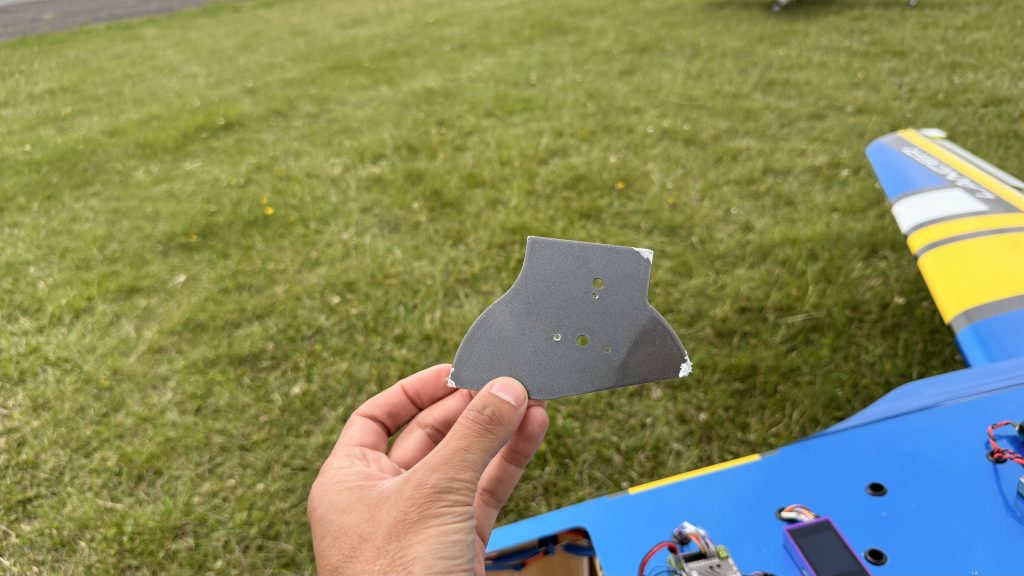
Gear door.
Applied the brakes, taxied back. Cut the turbine. We checked. One gear door missing, screw pulled out clean. The opposite door was scuffed. We pushed down on the model and noticed just how soft the retract springs are – the remaining door was easily touching the tarmac.
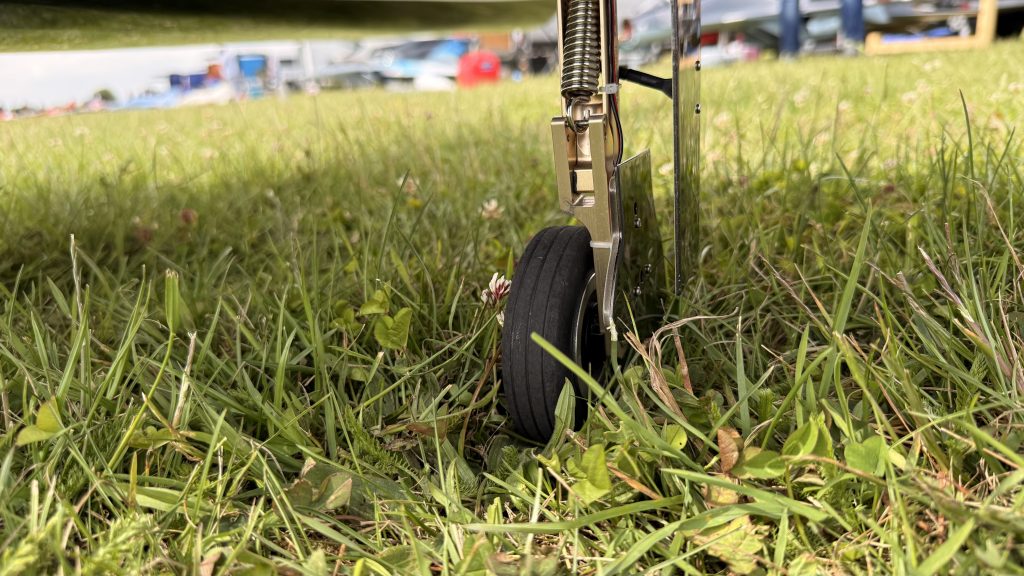
Lewis retrieved the missing door from the runway.
But she was down. Flight two was done, and it was more comfortable than the maiden.
Checking the Model Over — But Not Thoroughly Enough
I pushed the model back, canopy off, everything off.
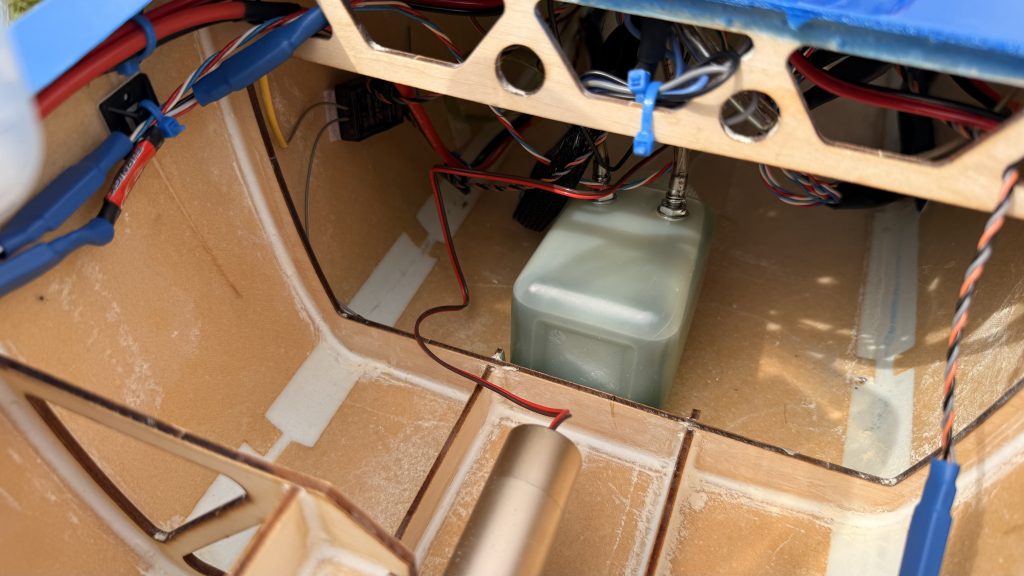
And that’s when I noticed the UAT tank had come loose. Lucky catch – those are used to prevent air bubbles entering the turbine during startup and flight.
I decided that was it for the day. Damaged gear door, loose UAT tank, but the Lancer had been maidened. Job done.
Smithy and I grabbed lunch at the Tibenham café – the airfield has a great little setup and Mick (or Mike?) had kindly opened it up for us. Solid food, Mick. Thanks.
After lunch I chilled on the grass, watched some brilliant flying from the other members, and reflected on my own flights while Smithy assembled something he’d been building up to all day – his Carf Su-30. More on that in a future post.
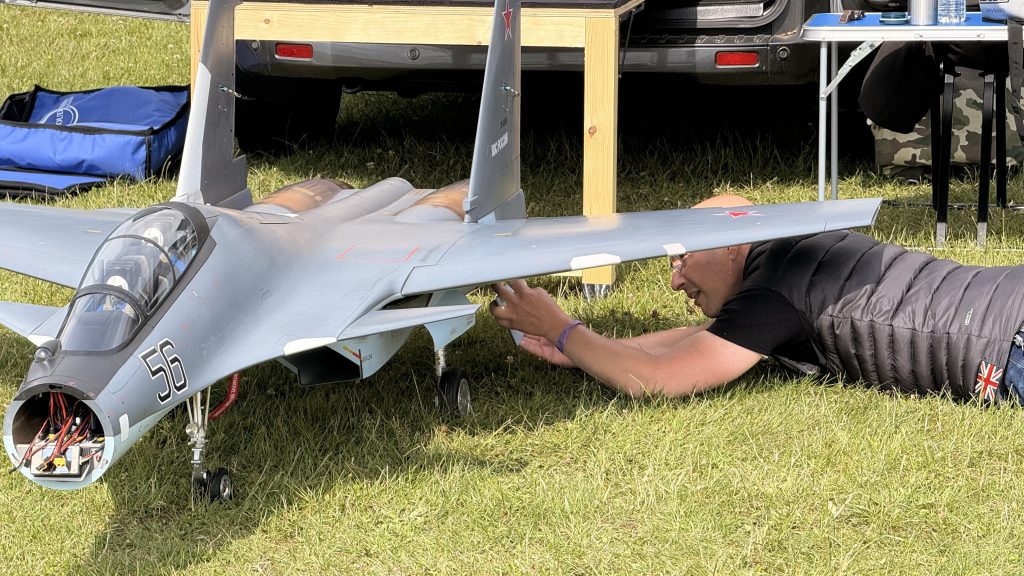
I grabbed some glue from Smithy, fixed the UAT tank – and fuelled up.
The Third Flight – The One I Recorded
Back in the queue around 5pm. The sun had shifted round and there was now a crosswind. Not severe, but just… another thing to factor in.
Smithy’s Su-30 was in the queue too. He kindly offered to let me go first and film my flight. Maybe he just needed a few more minutes to get into the zone.
Startup procedure, done. Taxied out. Lined up. Ready on the rudder for the crosswind.
Throttle up and away.
No drama on the climb out. Gear up, flaps up – but I think I banked a little early before the gear had fully retracted, and both Lewis and I could see something wasn’t right. I cycled the gear and confirmed it – one of the gear doors was hanging down and the nose door was still open.
The door that had come off on flight two. The other half of it. Still attached to the retract leg. Which I had completely forgotten to check after landing.
Lewis advised not to land yet — the model was still full of fuel and that’s a lot of extra weight. So I carried on flying circuits, just working on distance and flying big, getting more comfortable with each lap.
Timer. Gear down. Flyby to double-check. Flaps down. Lined up for final.
Similar to the second landing – didn’t quite come round far enough, risk of clipping the grass, some rudder correction for the crosswind. Then a smooth touchdown. And then – up elevator again. Another little bounce.
Brakes on. She stopped.
Third flight done. And honestly, slightly more comfortable than the second – even with a gear door dangling in the breeze.
That was it for me. Exhausted. Happy. Completely and utterly addicted.
A New Level of Respect
Having now actually flown a turbine-powered model, I have an entirely new respect for jet pilots.
They fly differently to prop planes. They eat up sky at a rate that catches you off guard. I found myself concentrating on a level I’ve never had to before, and I can imagine how quickly things could go wrong if your focus dips for even a moment – though that might just be inexperience talking.
Either way. Fair play. Serious respect.
Special Thanks
This day – and this whole build – wouldn’t have happened without a few key people:
Smithy – for talking me into going to JetPower 2025, where we first met FTL. This is all his fault.
Ben from FTL – for sponsoring the project and making the Lancer accessible. Massive one.
Paul at Nexus Models – for spending over an hour on the phone with me when I was ordering parts, taking the time to explain options and what everything actually does. Invaluable.
Revoc Customs – for the covers. More on those in a future post.
Advanced Radio – for providing their Smooth Flight 20 – I’m a massive fan!
Lewis Embling, David Taub, and everyone else on the day – the coaching, the calm, the flight conditions setup. Couldn’t have done it without you.
And the JMA – for welcoming a complete newbie and letting him loose on a turbine at their event. Legends, all of you.
Final Thoughts
I won’t pretend that first flight was fun. It wasn’t – not in the traditional sense. It was overwhelming, it was intense, and my hands shook from start to finish.
But here’s the thing.
By flight three, something had shifted. The fear hadn’t gone, but it had made room for something else. Confidence, maybe. Curiosity. The beginning of understanding.
That’s the thing about stepping so far outside your comfort zone that you can’t even see it behind you. The discomfort is real and it’s valid. But so is what’s waiting on the other side of it.
Can’t wait to go again.
Have you flown a turbine for the first time? Drop a comment below — I’d love to hear about your experience.
Over an out, Matt – Turbine Pilot (newbie)



You did amazing Matt, truly you took it all in your stride. It’s not an easy thing to turn up to an event like that, unfamiliar surroundings, new people, a completely alien environment. I can’t put better than you have already, so won’t but huge respect to you for this epic first step on what I’m sure will be a very long journey. Huge respect to the JMA, they’re fabulous champions for the hobby run by serious people who care and protect our little community. Next one’s in 3 weeks mate :-)
Yes i remember it well.it was word for word exactly the same as your experience. I didn’t enjoy it.worse than that I was given bad advice on the run time with my setup….I was so lucky as it went dead stick on final approach and glided in for a not so great landing…..survived with minor damage to one of the mains…..and just like you I was hooked and scared and excited all at the same time……jets are awesome and a marvel of modern tech and modelling…..keep on burning the kerosene it’s awesome fun….👍